Our Equatorial Guinea Meal
Our latest international cooking adventure took us to Equatorial Guinea, a small African country located just a few degrees north of the equator. Our meal consisted of Gallina en Salsa de Cacahuete (Chicken Peanut Stew), Succotash and Baked Plantain.
The Gallina en Salsa de Cacahuete was delicious over rice. It consisted of chicken, roasted peanuts, tomatoes, onion, garlic, cumin, oregano and paprika. The roasted peanuts gave it such a great nutty flavor.
I was not excited about making Succotash because I hate the texture of lima beans, which honestly I have not tried since I was a kid. One of those things that is probably delicious when prepared the right way or swimming in butter. But I decided to give it a try because Succotash is considered the national dish of Equatorial Guinea, even though its origin can be traced back to Native Americans in North America. The succotash was pretty good! Even the lima beans were good mixed in with everything else. It consisted of a lot of different vegetables: red and green bell pepper, tomatoes, onion, zucchini, sweet corn, green beans with some garlic and cumin.
The baked plantains were OK but not very sweet, I think because the plantains we used were not ripe enough. If we made them again we would buy them ahead of time to allow time to ripen.
The giraffe is the national animal of Equatorial Guinea so I was excited to use our little giraffe bowl! One of my favorites! 😊


About Equatorial Guinea
Equatorial Guinea, located on the west coast of Central Africa, was formerly Spanish Guinea and gained independence in 1968. It’s the only African country where Spanish is an official language. The country consists of a mainland and several islands, with its capital, Malabo, on Bioko Island.
The Fang people are the dominant ethnic group, making up about 85% of the total population. The Fang were victims of the trans-Atlantic and trans-Saharan slave trades between the 16th and 19th centuries. Slave traders and missionaries falsely labeled them as cannibals because human skulls and bones were found near their villages, which was used to justify violence and enslavement. It was later discovered by ethnologists that the Fang people stored ancestral bones in bark boxes known as “Byeri” reliquaries as a way to honor and remember departed loved ones. Each box typically held the skulls, femurs, and vertebrae and was topped with a carved Byeri figure that served as a spiritual guardian.
In the 1990s, an oil boom made Equatorial Guinea one of Africa’s richest nations, but wealth is unevenly distributed. Officials are planning for the oil to run out by 2035. Despite the wealth, over half the population lacks access to clean water, and unfortunately almost 8% of children die before age five, compared to less than 1% in the US.
Equatorial Guinea has some beautiful areas such as Pico Basilé, its highest peak and upper layer of rainforest; Islotes Horacio, a volcanic islet off Bioko’s coast, Bome beach in Bata, and remote Annobón Island, which is rich in biodiversity and culture.
Common foods include cocoyams, plantains, rice, peanuts, and occasional meat, such as goats, chickens, and even monkeys or snakes. Many people rely on what they can grow locally.
We watched Where the Road Runs Out, set in Equatorial Guinea, and really enjoyed it. The movie is about a scientist who returns to his African roots after the sudden death of a friend. He takes over a field station in the jungle, meets an orphan boy with a “sunny disposition,” and bonds with the lady who runs the local orphanage.
While watching GeographyGo (a spinoff of GeographyNow which is one of our favorite resources), we learned about a group called Most Traveled People which I find so interesting!
“MTP challenges its members to expand their horizons, by dividing the land area of Earth into 1500 distinct regions, including countries, states, territories, islands and enclaves. We also track the world’s top restaurants, hotels, beaches, dive sites, and all UNESCO World Heritage Sites. For many, adding to their MTP totals and turning their personal map from red to green is their life’s work. No one in history has ever completed the list!”


✈️ Tours to Some Beautiful Locations in Equatorial Guinea!🧳
What about you?
Please post your comments below. We love hearing other’s experiences and thoughts!
- Do you have a favorite meal, recipe or drink from Equatorial Guinea?
- Do you have a favorite place that serves food from Equatorial Guinea?
- Are you from Equatorial Guinea or have you ever visited?
Eritrea is Up Next!
Do you have a favorite meal, recipe or drink from ZZ?
Photos
- Pico Basilé – Amitsawant0812 – Own work, CC BY-SA 4.0, https://commons.wikimedia.org/w/index.php?curid=76575665
- Islote Horacio – By Denis Barthel – Own work, CC BY-SA 3.0, https://commons.wikimedia.org/w/index.php?curid=30392986
- Annobon – By Bioko Islander – Own work, CC BY-SA 3.0, https://commons.wikimedia.org/w/index.php?curid=15586877
- Fang Head – Cliff from Arlington, Virginia, USA, CC BY 2.0 https://creativecommons.org/licenses/by/2.0, via Wikimedia Commons
- Country Reports https://www.countryreports.org/country/EquatorialGuinea.htm
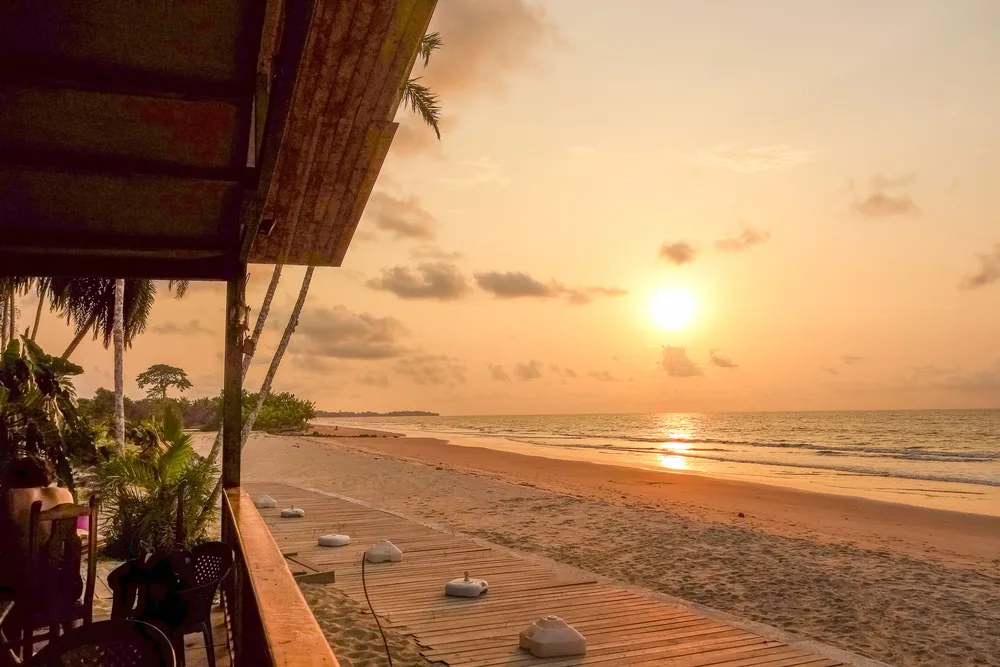
Featured Image: Sunset at Bome beach in Bata in Equatorial Guinea
References
Britannica, Country Reports, Geography Now, Global Table Adventures, The Travel Book, shutterstock and Wikipedia.